How to Structure Your HYROX Running Training (Science-Backed Weekly Plan)
If you're training for HYROX, you've probably heard conflicting advice about running. Some say "just run more miles." Others swear by high-intensity intervals. Most HYROX athletes end up stuck in the middle—running too hard to build aerobic capacity but not hard enough to improve VO₂ max.
The solution? Polarized training: one long slow run, one tempo session, and one high-intensity interval workout per week. This isn't just bro-science—it's backed by decades of endurance research and used by Olympic athletes across every endurance sport.
In this article, we'll break down the scientific evidence, show you exactly how to structure your weekly running, and explain why this approach delivers 3x better results than traditional training methods.
Gear Up Before You Start
Before diving into the training plan, make sure you have the right shoes and a way to track your training zones.
Shoes: You'll cover 8km of running between stations — the right shoe matters. Our top picks:

Great all-rounder for training and race day. Multiple colorways available.

The official HYROX race shoe. Several color options to match your race kit.

See all our shoe picks.
Watch: A GPS watch with heart rate tracking is essential for training by zones. The Garmin Forerunner 570 has an AMOLED display, advanced training metrics, and everything you need to train smarter.
- Garmin Forerunner 570 (42mm) — clean, sleek look for smaller wrists without sacrificing any features
- Garmin Forerunner 570 (47mm) — larger display, easier to read mid-run
Heart rate monitors (optional): For the most accurate zone training, a chest strap beats wrist-based HR.
- Garmin HRM-Pro Plus — gold standard chest strap
- Garmin HRM-Fit — clip-on design, great for women
See all our watch and HR monitor picks.
The Science: Why Polarized Training Works for HYROX
What is Polarized Training?
Polarized training, pioneered by exercise physiologist Dr. Stephen Seiler, is built on a simple principle: 80% of your training should be easy (Zone 2), and 20% should be hard (Zone 4-5). The middle ground—tempo pace (Zone 3)—is minimized.
This directly contradicts traditional threshold training, where athletes spend 40-50% of their time at moderate intensity. Research consistently shows polarized training produces superior results.
The Research Evidence
Study #1: Seiler & Kjerland (2006) analyzed the training intensity distribution of World and Olympic Champion endurance athletes across multiple sports. Their finding? Elite athletes spend approximately 75-80% of training time at low intensity, despite racing at much higher intensities[^1].
Study #2: Helgerud et al. (2007) compared four training protocols over 8 weeks:
- Long slow distance only: 3.5% VO₂ max improvement
- Continuous moderate intensity: 5.2% VO₂ max improvement
- 4×4 minute intervals at 90-95% max HR: 10.8% VO₂ max improvement
The interval group showed nearly 3x greater improvement than continuous training[^2].
Study #3: Stöggl & Sperlich (2014) directly compared polarized vs. threshold training in runners. After 9 weeks, the polarized group showed superior improvements in:
- 10km time trial performance
- VO₂ max
- Running economy
- Lactate threshold
The threshold group actually experienced decreased performance in some metrics[^3].
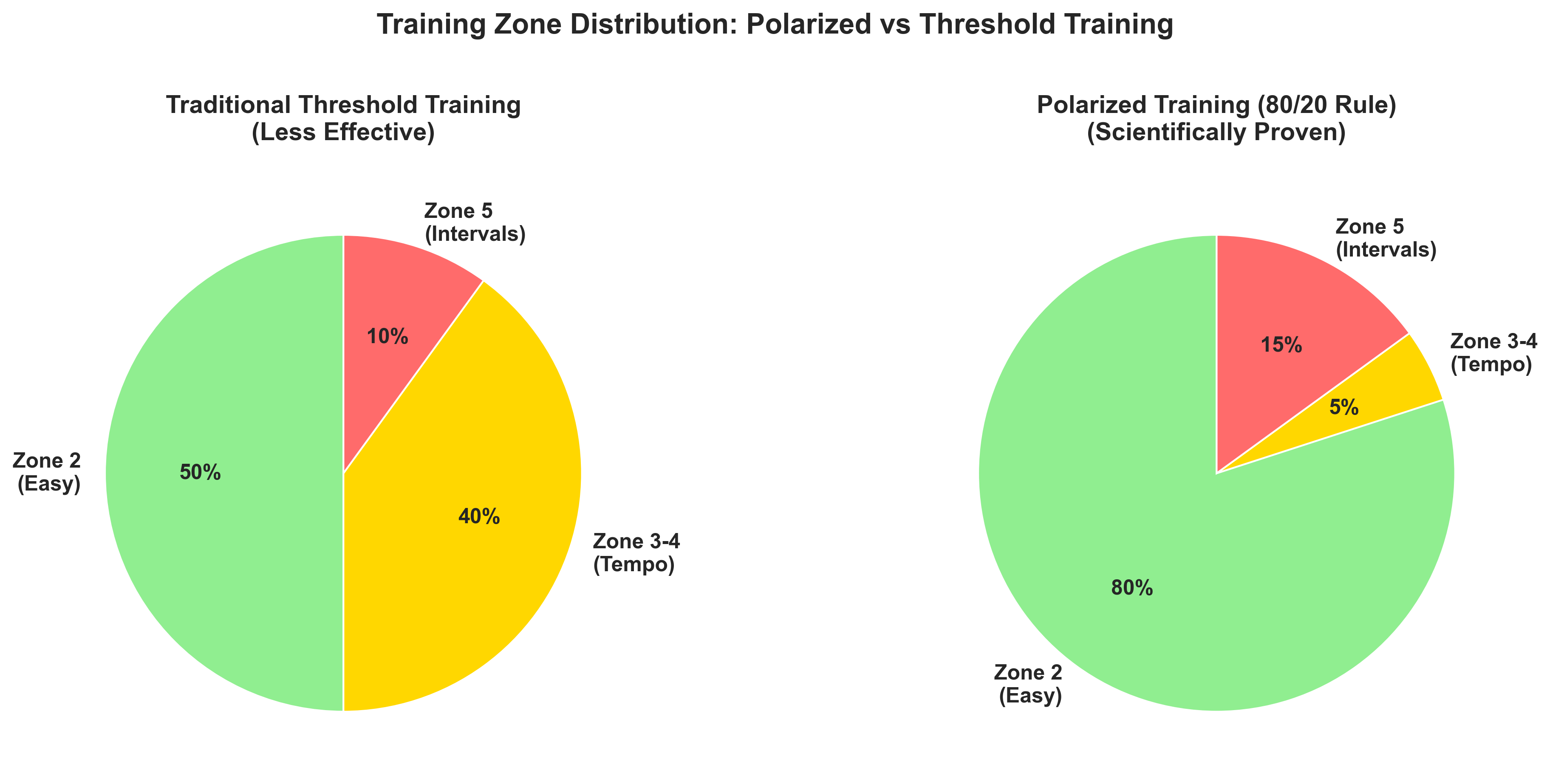 The 80/20 rule: Polarized training (right) produces better results than traditional threshold training (left)
Understanding the Three Training Zones
Before we dive into weekly structure, let's clarify what each training zone actually does for your HYROX performance.
Zone 2: Low-Intensity Aerobic Training (80% of volume)
Heart Rate: 60-70% of max HR
Talk Test: Full conversation possible
Duration: 60-90 minutes
Frequency: 1-2x per week for HYROX
What it does:
- Increases mitochondrial density (your cellular power plants)
- Improves fat oxidation (preserves glycogen for stations)
- Builds capillary networks (better oxygen delivery)
- Strengthens slow-twitch muscle fibers
- Enhances recovery capacity
HYROX benefit: You recover faster between stations and maintain pace through all 8km of running. This is your aerobic engine—the foundation everything else is built on.
Common mistake: Running Zone 2 too hard. If you can't hold a conversation, you're in Zone 3 (the "gray zone") and missing the adaptations. Slow down.
Tempo Training: Lactate Threshold Work (~5% of volume)
Heart Rate: 75-85% of max HR
Talk Test: Short sentences only (3-5 words)
Duration: 20-40 minutes at tempo pace
Frequency: 1x per week
What it does:
- Raises lactate threshold (push harder before fatigue)
- Improves lactate clearance
- Teaches your body to maintain hard efforts
- Mental toughness at race pace
HYROX benefit: This is closest to your average HYROX running pace between stations. You're training your body to sustain that "comfortably hard" pace for the entire race.
Common mistake: Going too hard and turning tempo into an interval session. Tempo should be steady and sustainable for 20-40 minutes—not all-out.
High-Intensity Intervals: VO₂ Max Training (~15% of volume)
Heart Rate: 90-95% of max HR
Talk Test: 1-2 words maximum
Duration: 3-5 minutes per interval, 4-8 intervals
Frequency: 1x per week
What it does:
- Maximal VO₂ max improvements
- Increases stroke volume (heart pumps more blood per beat)
- Improves oxygen extraction by muscles
- Raises ceiling on all other training
HYROX benefit: When you hit that brutal Wall Ball station after 8km of running, your VO₂ max determines how well you perform under extreme fatigue. Higher VO₂ max = better oxygen delivery when you need it most.
Common mistake: Not going hard enough. Intervals should be genuinely uncomfortable. If you can chat during the work portion, increase intensity.
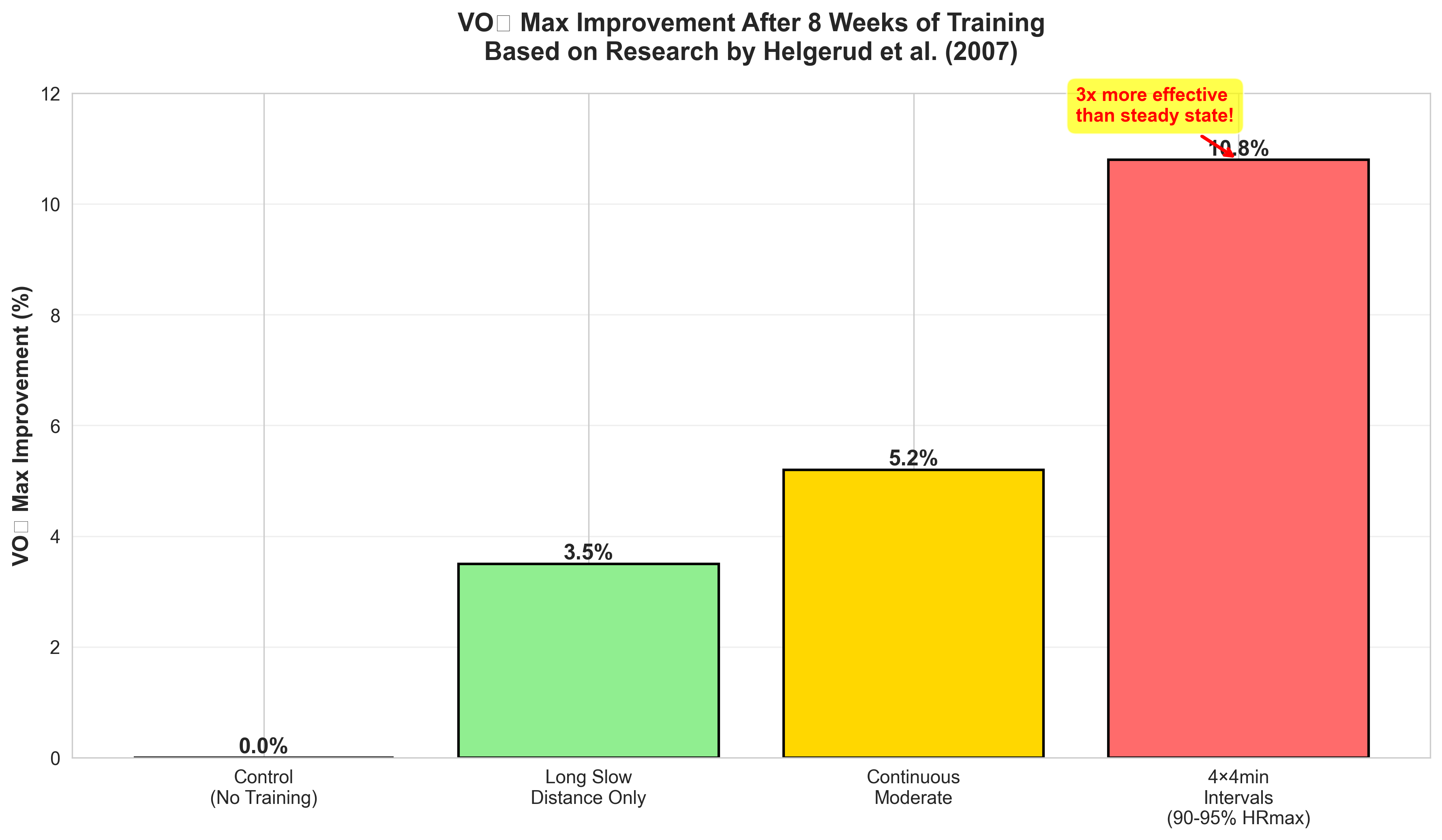 Research shows 4×4 minute intervals produce 3x greater VO₂ max improvements than steady-state training
Your Weekly HYROX Running Structure
Here's how to put it all together: 3 running sessions + 2 HYROX strength sessions per week.
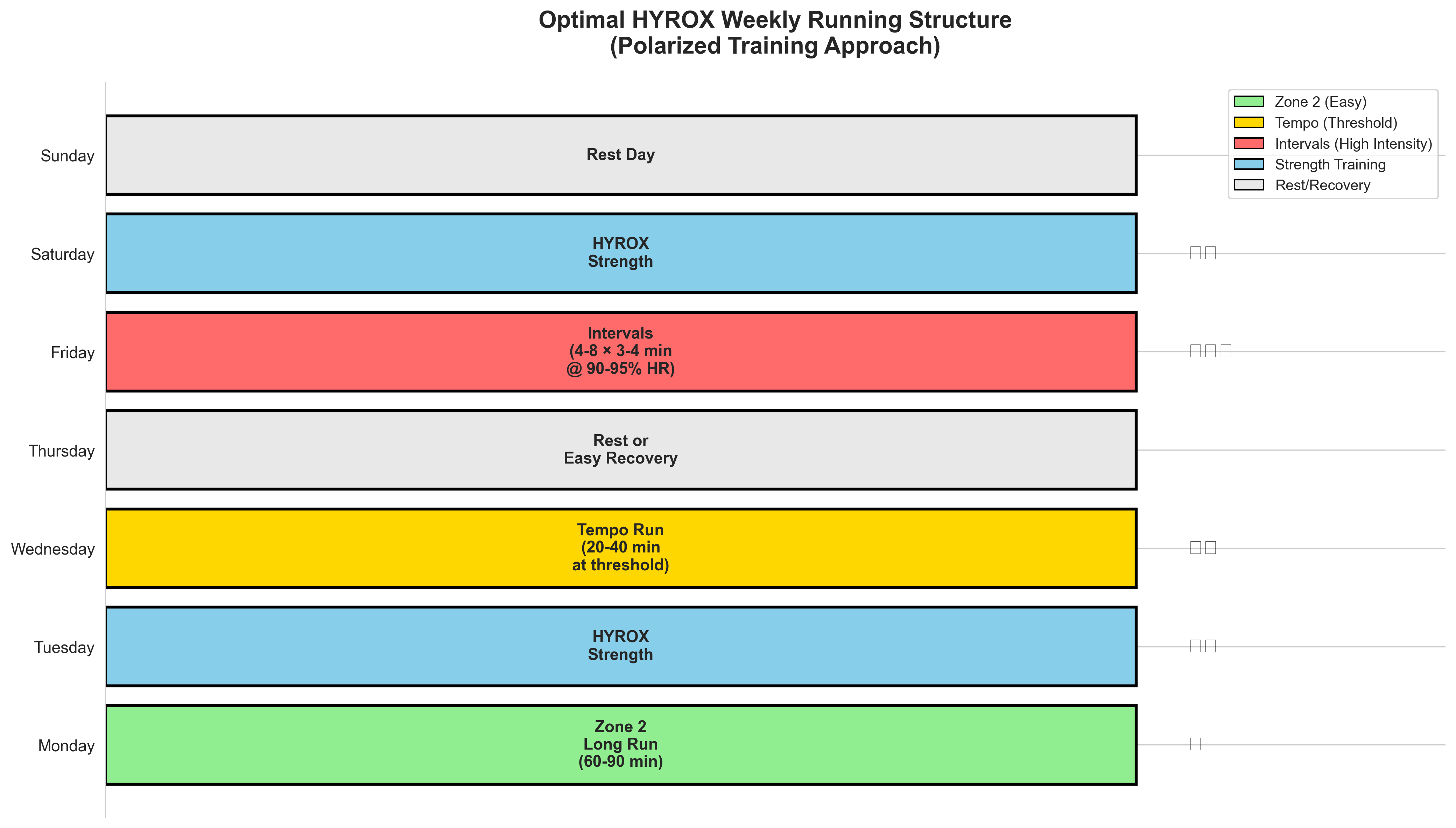 Optimal weekly structure balancing intensity, volume, and recovery
Monday: Zone 2 Long Run (60-90 minutes)
Purpose: Build aerobic base and fat oxidation
Intensity: 60-70% max HR (conversational pace)
Structure:
- 10 min easy warm-up
- 40-70 min Zone 2 effort
- 10 min easy cool-down
Why Monday? You're fresh from weekend rest. Long runs require mental focus—do them when you're sharp.
Progression: Add 5-10 minutes every 2-3 weeks until you hit 90 minutes. Don't exceed 90 minutes—this isn't marathon training.
Pro tip: Practice race nutrition during long runs. Eat/drink at the same intervals you'll use in HYROX. Learn what your stomach can handle at this effort.
Tuesday: HYROX Strength Training
Purpose: Train the 8 stations while legs are still fresh from easy Zone 2 run
Structure:
- Choose 4-6 stations per session
- 2-3 rounds at race weight
- Focus on technique and power
- Short transition runs between stations
See our complete HYROX training guide for station-specific workouts.
Why Tuesday? Your legs aren't fatigued from Zone 2 (it's aerobic, not damaging). You can train stations with good quality.
Wednesday: Tempo Run (20-40 minutes)
Purpose: Raise lactate threshold
Intensity: 75-85% max HR
Structure:
- 10 min easy warm-up
- 20-40 min tempo (should feel "comfortably hard")
- 10 min easy cool-down
How it should feel: You're pushing, but could theoretically hold this pace for an hour. Not all-out, but definitely working.
Progression:
- Weeks 1-4: 20 minutes tempo
- Weeks 5-8: 25-30 minutes tempo
- Weeks 9-12: 30-40 minutes tempo
HYROX connection: This pace is typically your average running pace between HYROX stations. You're teaching your body to sustain race effort.
Thursday: Rest or Easy Recovery
Purpose: Prepare for Friday's high-intensity intervals
Options:
- Complete rest (recommended for most)
- 20-30 min very easy recovery jog
- Light mobility and stretching
- Easy swimming or cycling
Why Thursday? You need to be fresh for Friday's intervals. Tempo on Wednesday is demanding, and intervals on Friday are brutal. Rest here is strategic.
Key: Don't skip this. Going into intervals fatigued ruins the session quality and increases injury risk.
Friday: High-Intensity Intervals
Purpose: Maximize VO₂ max
Intensity: 90-95% max HR
Structure:
- 10-15 min easy warm-up
- 4-6 strides (20 sec accelerations)
- Main set: 4-8 × 3-4 min hard / 2-3 min easy jog recovery
- 10 min easy cool-down
The Magic Protocol: Research by Helgerud et al. showed 4 × 4 minutes at 90-95% max HR with 3-minute active recovery produced the greatest VO₂ max improvements[^2].
Progression:
- Weeks 1-4: 4 × 3 min (90% HR)
- Weeks 5-8: 6 × 3 min (92% HR)
- Weeks 9-12: 4-6 × 4 min (90-95% HR)
Pro tip: Track your heart rate recovery. If HR doesn't drop below 65% during rest intervals, you're not recovered enough. Extend rest or reduce interval length.
Why Friday? You're fresh from Thursday's rest, so you can push maximum intensity. Weekend recovery follows.
Saturday: HYROX Strength Training
Purpose: Train the 8 stations with race-specific focus
Intensity: Moderate-high (you're fatigued from the week, but stations need work)
Structure:
- Choose 4-6 stations per session
- 2-3 rounds at race weight
- Focus on technique under fatigue
- Include short transition runs between stations
See our complete HYROX training guide for station-specific workouts.
Why Saturday? You've already done your hardest running for the week. Saturday station work simulates race conditions—training stations when you're already fatigued from running.
Progression: Rotate stations each week to ensure you hit all 8 over a 2-week cycle.
Sunday: Complete Rest
Purpose: Full recovery before the cycle repeats
Activity: Nothing structured. Walk, light mobility, enjoy life.
Why it matters: Growth happens during rest. You have two hard running days (Wednesday + Friday) and two strength days (Tuesday + Saturday) in the week. Full rest on Sunday lets you start Monday's long run fresh.
Common Questions & Mistakes
"Can I add more running?"
No. More is not better—better is better. The 80/20 distribution works because it allows quality in your high-intensity sessions. Add more volume, and you'll be too fatigued to hit proper intensities on interval day.
If you're coming from a pure running background, you might feel like this isn't enough mileage. Remember: HYROX adds 8 brutal station workouts on top of the running. Train smarter, not just harder.
"What if I can't run 90 minutes?"
Start where you are. If 40 minutes is your current long run, that's fine. Add 5-10 minutes every 2-3 weeks. The principles remain the same regardless of your current fitness level.
"Can I do two interval sessions per week?"
Only if you're an advanced athlete with 5+ years of structured endurance training. For most HYROX competitors, two high-intensity running sessions plus station training equals overtraining.
The research is clear: more intensity doesn't equal more improvement. It equals injury and burnout.
"Why not just do HYROX classes for all my training?"
Most HYROX gym classes are Zone 3-4 ("gray zone") work—too hard to build aerobic capacity, not hard enough to maximize VO₂ max. They're great for technique and fun, but shouldn't replace structured running training.
Use HYROX classes for station practice 1-2x/week, but do your running separately where you can control intensity precisely.
The Gray Zone Problem
The biggest mistake HYROX athletes make? Spending too much time in Zone 3 (70-80% max HR). It feels like you're working hard, so it must be effective, right?
Wrong.
Zone 3 provides enough stress to create fatigue but not enough stimulus to drive adaptations. You're too tired to recover properly, but not training intensely enough to improve VO₂ max. It's the worst of both worlds.
Research by Seiler showed that elite athletes actively avoid Zone 3, except for occasional tempo sessions. They go easy or go hard—nothing in between[^1].
Signs you're stuck in the gray zone:
- Always moderately tired
- Plateaued performance despite training consistently
- Can't hit target paces on interval days
- Poor recovery between sessions
- Declining motivation
The fix: Slow down your easy days. Speed up your hard days. Trust the polarization.
Measuring Your Training Zones
You need objective feedback. "Feel" is too subjective, especially as fitness improves.
Option 1: Heart Rate Training (Recommended)
Find your max HR:
- Method 1: 220 - age (rough estimate)
- Method 2: Field test (warm up, then run 4 min all-out uphill—your max HR at end is ~max)
- Method 3: Lab test (most accurate, but unnecessary for most athletes)
Calculate zones:
- Zone 2: 60-70% of max HR
- Tempo: 75-85% of max HR
- Intervals: 90-95% of max HR
Best devices: Chest strap HR monitors are more accurate than wrist-based — see our watch and HR monitor recommendations above.
Option 2: Talk Test (Free)
- Zone 2: Full conversation possible
- Tempo: Short sentences (3-5 words)
- Intervals: 1-2 words maximum
Surprisingly accurate when used honestly.
Option 3: Power (Advanced)
Running power meters (Stryd) provide the most precise training feedback but require investment and learning curve.
Adapting for Different Experience Levels
Beginner (First HYROX or under 1 year endurance training)
Weekly Structure:
- Long Run: 40-60 min
- Tempo: 20 min
- Intervals: 4 × 3 min
- Total: 2-3 runs/week + 2 HYROX strength sessions
Focus: Build consistent training habit. Master Zone 2 pacing (most beginners run this too hard).
Intermediate (2-3 HYROX races, 1-3 years training)
Weekly Structure:
- Long Run: 60-75 min
- Tempo: 25-30 min
- Intervals: 5-6 × 3-4 min
- Total: 3-4 runs/week + 2 HYROX sessions
Focus: Precise execution of intensities. Track data. Build consistency.
Advanced (Multiple podiums, 3+ years structured training)
Weekly Structure:
- Long Run: 75-90 min
- Tempo: 30-40 min
- Intervals: 6-8 × 4 min or specialized workouts
- Total: 4-5 runs/week + 2-3 HYROX sessions
Focus: Periodization, race-specific work, fine-tuning weaknesses.
Sample 12-Week Progression
Weeks 1-4: Base Building
- Long Run: 40 → 50 → 60 → 65 min
- Tempo: 20 min steady
- Intervals: 4 × 3 min
Focus: Establish Zone 2 discipline, build volume progressively.
Weeks 5-8: Build Phase
- Long Run: 70 → 75 → 80 → 75 min
- Tempo: 25 → 30 → 30 → 25 min
- Intervals: 5 × 3 min → 6 × 3 min → 5 × 4 min → 4 × 4 min
Focus: Increase intensity on hard days while maintaining easy days easy.
Weeks 9-10: Race Simulation
- Long Run: 60-70 min + race-pace pickups
- Tempo: 25-30 min at goal race pace
- Intervals: 4-6 × 4 min with full recovery
Focus: Practice race-specific efforts, nail pacing.
Weeks 11-12: Taper
- Reduce volume by 40-50%
- Maintain intensity on 1 interval session (4 × 3 min)
- Extra rest
Focus: Arrive fresh. Trust the training.
Integration with HYROX Station Training
Your complete weekly schedule might look like:
- Monday: Zone 2 Long Run
- Tuesday: HYROX Strength (stations)
- Wednesday: Tempo Run
- Thursday: Rest or easy recovery
- Friday: Interval Running
- Saturday: HYROX Strength (stations)
- Sunday: Complete Rest
Notice the alternating pattern between running and strength. This prevents overloading the same energy systems consecutive days.
For detailed HYROX station training, see our complete training plan and station performance analysis.
Tracking Progress
Measure these metrics every 4 weeks:
1. Zone 2 Drift Test
- Run 60 min Zone 2 (constant HR)
- Track pace every 10 min
- Less pace drift = better aerobic fitness
2. Threshold Pace
- 20-30 min time trial at tempo effort
- Average pace = your current threshold
- Should improve 5-10 sec/km every 4-8 weeks
3. Interval Power
- Track average pace on 4 × 4 min intervals
- Consistent improvement = training is working
4. RHR (Resting Heart Rate)
- Measure upon waking
- Declining RHR = improving fitness
- Elevated RHR = check recovery/stress
Don't obsess over daily fluctuations. Look for trends over 4-week blocks.
The Bottom Line
Polarized training isn't new or revolutionary—it's what elite endurance athletes have done for decades. The research is overwhelming:
✅ 80% Zone 2 + 20% High Intensity beats threshold training
✅ 4 × 4 min intervals produce 3x greater VO₂ max gains
✅ One long run, one tempo, one interval session per week is optimal for HYROX
Stop training in the gray zone. Go easy when it's easy. Go hard when it's hard. Trust the science.
Your HYROX performance will thank you.
Frequently Asked Questions
Q: How long does it take to see improvements from polarized training?
A: Most athletes notice improvements within 4-6 weeks. Significant VO₂ max gains appear after 8-10 weeks of consistent training. Remember: fitness is built in months and years, not weeks.
Q: Can I do all my running on a treadmill?
A: Yes, but vary the incline to better simulate HYROX race conditions. Set treadmill to 1-2% incline for "flat" running to account for lack of air resistance.
Q: What if I miss a workout?
A: Skip it and move on. Don't try to "make up" missed sessions—this disrupts the training pattern. Consistency over perfection.
Q: Should I do strength training before or after running?
A: Ideally separate them by 6+ hours. If you must combine, do the priority workout first. On tempo/interval days, running comes first.
Q: How much does running contribute to HYROX success?
A: Running is 40-50% of your race time. You can't win HYROX with running alone, but poor running will definitely cost you. Master both.
Q: What about doubles (two sessions per day)?
A: Only for advanced athletes with 10+ hours/week to train. Most HYROX competitors don't need doubles and risk overtraining.
Want a complete running plan based on these principles? Our 10-Week HYROX Running Program applies everything in this article — polarized training, long runs, tempo, and intervals — into a structured 10-week plan with pacing tables for all fitness levels. Just $19.99. For the full training package including strength and stations, see the 12-Week Training Program.
Free Tools: Pacing Calculator — Set split targets for your goal time | Race Analyzer — Find your weakest stations
Related Articles: