Not all HYROX stations are created equal. While every station matters, some show dramatically larger time differences between advanced and intermediate athletes. Understanding which stations offer the greatest opportunity for improvement is crucial for efficient training.
We analyzed 700,000+ race results from athletes finishing in 1:20 (advanced), 1:30 (intermediate), and 1:40 (recreational) brackets. The findings reveal where slower athletes lose the most time - and where focused training can yield the biggest gains.
Key Takeaway
Note on Running: While this analysis focuses on workout stations, running accounts for ~50-55% of total race time and shows significant variance between brackets (8+ minutes difference). We cover running strategy and pace management in detail in our article The Mid-Race Crisis: When and Why You Slow Down.
The Variance Analysis
Time variance measures how much the average time differs between the fastest (1:20) and slowest (1:40) brackets for each station. Stations with high variance represent larger improvement opportunities - these are where fitness level has the biggest impact.
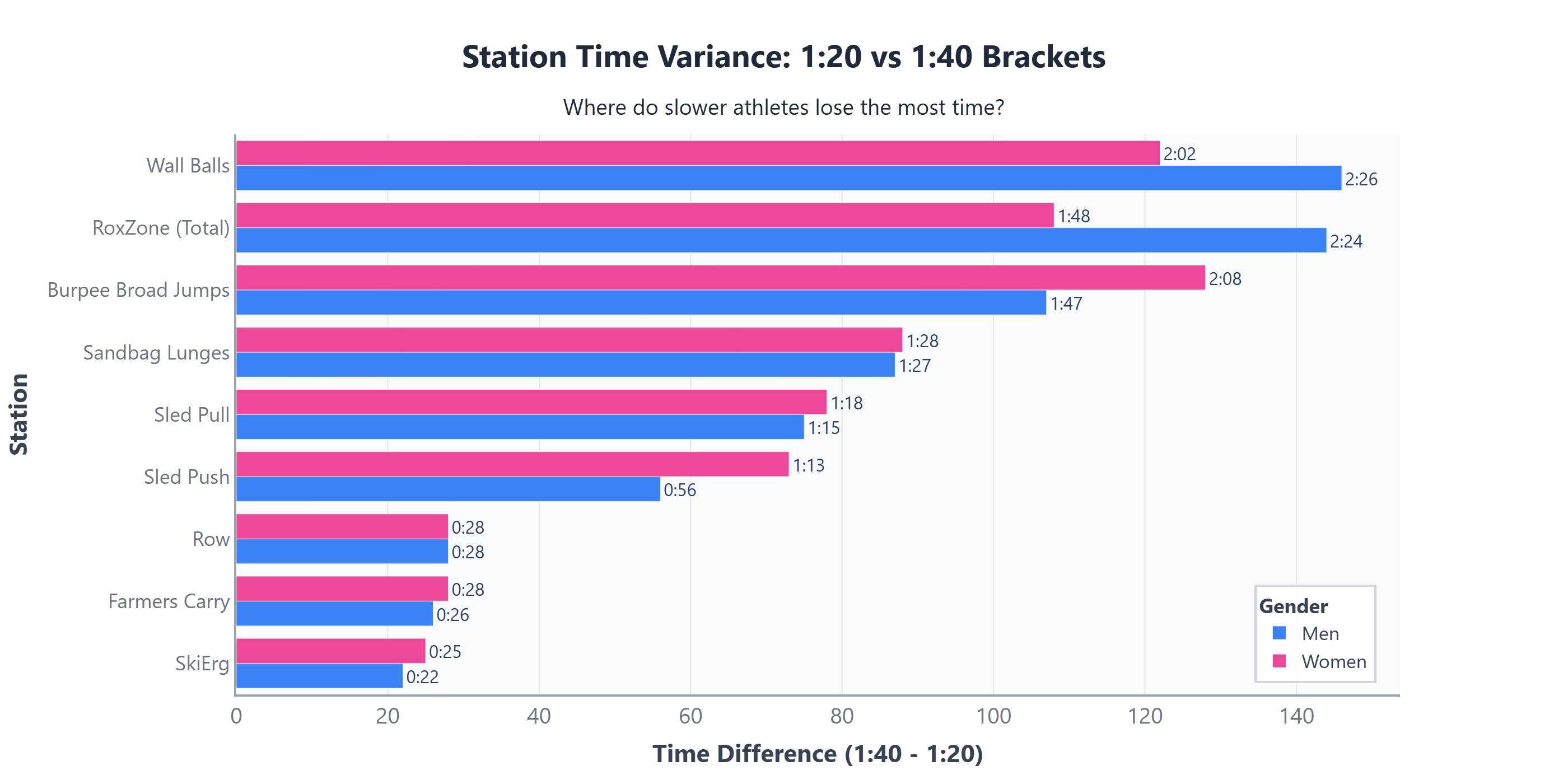
The chart above ranks stations by their time variance between brackets. The longer the bar, the more time separates advanced from recreational athletes on that station.
High-Impact Stations: Where Time Is Won or Lost
Wall Balls: The #1 Differentiator
Time Variance: Men 2:26, Women 2:02
Wall Balls consistently emerge as the single biggest separator between brackets. Advanced male athletes average 5:36, while recreational athletes take 8:02 - a massive 146-second difference. For women, the gap is 122 seconds (4:28 vs 6:30).
Why such a large gap?
- Requires sustained strength endurance (100 reps)
- Technique breaks down under fatigue
- Height disadvantage compounds over many reps
- Mental challenge of high rep count
Training implication: Even moderate Wall Ball improvements translate to significant time savings. A 20% improvement for a recreational athlete means saving ~90 seconds on this station alone.
RoxZone: The Hidden Time Drain
Time Variance: Men 2:24, Women 1:48
RoxZone - the cumulative time spent transitioning between stations - is the second-largest differentiator. Advanced athletes average ~21 seconds per transition (total ~5:45), while recreational athletes take ~30+ seconds (total ~8:10).
What's happening:
- Advanced athletes recover faster between efforts
- Better movement efficiency and station setup
- Less hesitation and quicker mental transitions
- Superior cardiovascular fitness enables faster recovery
Training implication: RoxZone improvements are "free" time savings - they require no additional fitness, just practice and efficiency. Saving 5 seconds per transition = 40 seconds total.
Burpee Broad Jumps: Technique + Power
Time Variance: Men 1:47, Women 2:08
This station shows high variance, particularly for women (128 seconds difference). The combination of explosive power, coordination, and cardio endurance creates a challenging test that separates fitness levels.
Key factors:
- Burpee technique efficiency
- Broad jump power and technique
- Pace management over 80 meters
- Fatigue resistance
Medium-Impact Stations
Sandbag Lunges (1:27 variance), Sled Pull (1:16), and Sled Push (1:04) show moderate variance. These stations still offer improvement opportunities but to a lesser degree than the top three.
These stations are more "democratized" - recreational athletes can achieve respectable times with proper technique, even without elite fitness levels.
Low-Impact Stations: Less Leverage
Row (0:28 variance), Farmers Carry (0:27), and SkiErg (0:23) show the smallest time differences between brackets. While you should still train these movements, they offer less leverage for time improvement compared to high-variance stations.
Why such small variance?
-
More technique-dependent (skill matters more than pure fitness)
-
Shorter duration (less time to accumulate differences)
-
Equipment limits (can't go faster than machine/implement allows)
-
Natural movement patterns (less specialized)
What About Running?
It's important to note that while this analysis focuses on workout stations, running is actually the largest component of HYROX - accounting for approximately 50-55% of total race time. The variance in total running time between brackets is substantial (8+ minutes difference from 1:20 to 1:40).
However, running improvement is a different beast - it's about aerobic base development, pacing strategy, and managing pace degradation across the race. We cover this in depth in our dedicated running analysis: The Mid-Race Crisis: When and Why You Slow Down.
The optimal approach: Build your aerobic base through consistent running (the foundation), then layer in station-specific work focused on the high-variance stations identified above. You need both, but they're developed differently.
The 70/30 Training Strategy
Based on this analysis, here's how to allocate your HYROX-specific training time:
70% of station-specific work:
- Wall Balls - Technique, pacing, and endurance work
- Transition Practice - Mock RoxZone setups and practise compromised running
- Burpee Broad Jumps - Technique refinement and power development
30% of station-specific work: 4. Sled movements (Push/Pull) 5. Sandbag Lunges 6. Remaining stations (Row, Farmers, SkiErg)
This doesn't mean ignore the "low-impact" stations - it means prioritize your time wisely. A 10% improvement in Wall Balls saves you more time than a 20% improvement in SkiErg.
Priority Matrix: Your Action Plan
| Priority Level | Stations | Total Potential Time Savings |
|---|---|---|
| High | Wall Balls, RoxZone, Burpee Broad Jumps | 6-8 minutes |
| Medium | Sandbag Lunges, Sled Pull, Sled Push | 3-4 minutes |
| Low | Row, Farmers Carry, SkiErg | 1-2 minutes |
Key Takeaway
Focus your training on high-variance stations. Improving your Wall Balls by 90 seconds, tightening your RoxZone by 60 seconds, and shaving 45 seconds off Burpees could drop your total time by over 3 minutes - without improving your running at all.
Practical Application
For 1:30 athletes targeting 1:20: Your biggest opportunities are Wall Balls (save over 1 min) and RoxZone (save over 1 min). Focus here first combined with aerobic capacity.
For 1:40 athletes targeting 1:30: Wall Balls (save ~1:15), RoxZone (save ~1:15), and Burpees (save ~1 min) offer the most potential in combination with aerobic capacity.
For all athletes: Track your split times for each station and compare them to your target bracket averages. Identify your worst 2-3 stations relative to the benchmark and make them training priorities.
Beyond the Numbers
While this analysis reveals where time differences exist, remember that your individual strengths and weaknesses matter. If your Wall Balls are already competitive but your SkiErg is significantly slower than average, address your personal limiters first.
Use this analysis as a framework for efficient training allocation, but personalize it based on your race results and current abilities.
Ready to train your weaknesses? Our 12-Week Training Program ($29.99) targets every station and running segment. If running between stations is where you lose the most time, our 10-Week Running Program ($19.99) focuses on building speed and fatigue resistance.
Related Articles:
- The Mid-Race Crisis: When and Why You Slow Down — Manage pace degradation
- The Hidden 3 Minutes: RoxZone Efficiency — Master transitions
- HYROX Sandbag Lunges Strategy — Attack the lunges
- HYROX Running Strategy — Run smart, not just fast
- Pacing Calculator Guide — Plan your splits
Try It Yourself:
Interactive Race Analyzer — Compare your station times against 700,000+ real race results by category and finish time