Breaking 1:30:00 in HYROX is a significant milestone - it puts you in the top 25-30% of competitors and signals serious fitness. But what does it actually take? We analyzed 700,000+ race results to reverse-engineer the exact benchmarks you need to hit.
Key Takeaway
The Bottom Line: To beat 1:30, men need a ~55-minute 10k ability and solid strength-endurance (50+ unbroken wall balls). Women need a ~57-minute 10k and similar station proficiency. This is very achievable for dedicated athletes with 6-12 months of focused training.
The 1:30:00 Breakdown
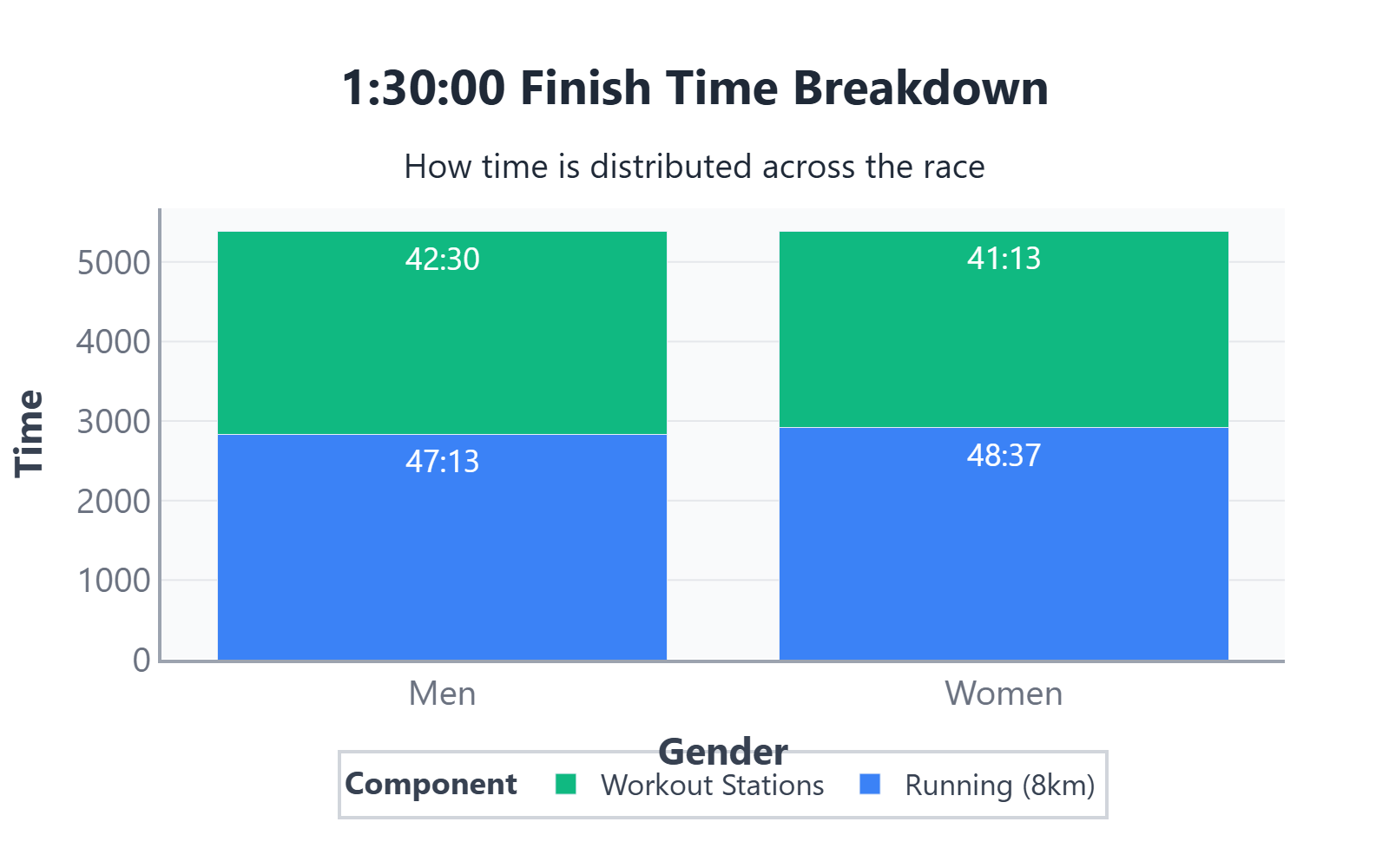
Men vs Women: Different Paths, Same Finish Time
Men (1:30:00):
- Running: 47:13 (52.5% of race)
- Stations: 35:50 (39.8% of race)
- RoxZone: 6:57 (7.7% of race)
Women (1:30:00):
- Running: 48:37 (54.1% of race)
- Stations: 34:43 (38.5% of race)
- RoxZone: 6:40 (7.4% of race)
The data reveals an interesting pattern: women finishing at 1:30 run slightly slower but make up time on the stations. This reflects physiological differences in strength-to-weight ratios and running economy.
Running Requirements: The Foundation
The Numbers
Men: 47:13 total (8km) = 5:54/km average
Women: 48:37 total (8km) = 6:04/km average
What This Means for Your Training
These paces are under fatigue, with station breaks. Your fresh 10k time needs to be faster to account for the unique demands of HYROX.
Equivalent 10k Times:
- Men: Sub-55:30 (5:33/km)
- Women: Sub-57:00 (5:42/km)
Why the difference? In HYROX, you're running in 8 × 1km chunks, each preceded by a strength station. This breaks up your running rhythm but also provides brief recovery. Athletes typically run 5-8% slower than their fresh 10k pace.
Training Prescription: Running
To start building the aerobic base for 1:30:
- Base Volume: 30-40km per week minimum
- Long Run: Weekly 10-15km easy run (6:00-6:30/km)
- Tempo Work: 2× weekly tempo sessions at 5:15-5:30/km for 20-30 minutes
- Intervals: 1x weekly 8 x 1km at 5:00-5:15/km with 90s rest (race-specific)
- Brick Sessions: Monthly combined workouts (e.g., 1km run → 80 wall balls → 1km run)
Increase running volume slowly to avoid injury. Increase or decrease the tempo for your fitness level.
Critical insight: Don't chase a sub-50 10k. A 55-minute runner with excellent station proficiency beats a 50-minute runner with weak stations every time. Balance is key.
Station Requirements: The Make-or-Break
The Benchmarks (Based on 1:30 Athletes)
| Station | Men Target | Women Target | Training Benchmark |
|---|---|---|---|
| SkiErg | 4:25 | 4:57 | 1000m under 4:30, sustainable pace |
| Sled Push | 3:07 | 2:45 | 152kg/102kg: controlled movement, short stops |
| Sled Pull | 4:43 | 4:37 | 103kg/70kg: steady pulls, efficient technique |
| Burpee Broad Jumps | 5:03 | 5:18 | 18-20 reps/min, consistent rhythm |
| Row | 4:47 | 5:15 | 1000m under 4:50, maintain 1:12 splits |
| Farmers Carry | 2:17 | 2:23 | no stops, fast transitions |
| Sandbag Lunges | 4:45 | 4:48 | continuous movement, steady pace |
| Wall Balls | 6:30 | 5:20 | 50-60 unbroken reps minimum |
The Big Three: Where Time Is Won or Lost
Based on our Station Performance Analysis, three stations differentiate 1:30 from slower finishers:
1. Wall Balls (Target: 6:30 men, 5:20 women)
This is the single biggest differentiator. Athletes who struggle here can lose 3-5 minutes to target pace.
Training:
- 3× weekly wall ball practice
- Build to 100 unbroken reps in training
- Practice after leg workouts to simulate race fatigue
- Focus on rhythm and breathing, not speed
2. Burpee Broad Jumps (Target: 5:03 men, 5:18 women)
The most metabolically demanding station. Poor pacing here destroys your next run.
Training:
- 2x weekly BBJ-specific work
- Start with 5 x 10 reps with 60s rest, build to 3 x 20 with 90s rest
- Practice consistent, sustainable pace (not sprinting)
- Emphasize explosive hip extension
3. Sled Work (Target: Push 3:07/2:45, Pull 4:43/4:37)
Technique and leg strength are equally important.
Training:
- 1× weekly heavy sled work (120-150% body weight)
- Focus on continuous movement - stopping costs massive time
- Push: low stance, drive through quads
- Pull: hand-over-hand technique, full range of motion
RoxZone: The Hidden Opportunity
Target: 6:57 (men), 6:40 (women) = ~26 seconds per transition
Most athletes waste 10-20 seconds per transition through poor planning, unnecessary rest, or disorganization. Over 8 transitions, this adds 2-3 minutes to your finish time.
How to Train RoxZone
You can't "train" RoxZone in isolation - it's a function of:
- Overall fitness (better aerobic base = faster recovery)
- Efficiency (pre-planned equipment setup, minimal faffing)
- Mental toughness (moving when you want to rest)
The best RoxZone training is brick workouts: Station → immediate transition → run, focusing on moving efficiently under fatigue.
Putting It All Together: A 12-Week Plan
Phase 1: Build the Base (Weeks 1-4)
Running: 30km/week, mostly easy pace
Stations: 2× weekly strength-endurance circuits (lighter weights, higher reps)
Goal: General fitness, movement proficiency
Phase 2: Develop Specific Capacity (Weeks 5-8)
Running: 35-40km/week, add weekly tempo + intervals
Stations: 3× weekly HYROX-specific work (wall balls, sleds, BBJs at target weights)
Brick: 1× weekly combined session
Goal: Build race-specific fitness
Phase 3: Sharpen and Peak (Weeks 9-12)
Running: Maintain volume, increase intensity (more race-pace work)
Stations: Focus on weaknesses, simulate fatigue (e.g., wall balls after leg workout)
Brick: 2× weekly combined sessions
Race Simulation: Week 10 - full HYROX simulation at 95% effort
Taper: Week 12 - reduce volume 40%, maintain intensity
Reality Check: Is 1:30 Realistic for You?
You're Ready for a 1:30 Attempt If:
✅ You can run 10km in under 56 minutes (men) or 58 minutes (women)
✅ You can complete 60 unbroken wall balls (9kg/6kg)
✅ You've done multiple brick workouts combining running + stations
✅ Your biggest station weakness is under 90 seconds off target pace
✅ You have 6+ months of consistent training
You're Not Ready Yet If:
❌ Your 10k time is >62 minutes
❌ You can't complete 40 unbroken wall balls
❌ You've never trained sleds or carries
❌ You're brand new to HYROX (target 1:45 first, then build)
The good news: With focused training, most athletes can go from 1:45 to 1:30 in 6-9 months. From 1:30 to 1:20 takes longer (12-18 months) because margins get tighter.
Common Mistakes to Avoid
1. Overemphasizing Running
Yes, running is 50%+ of the race. But going from a 55-minute to 52-minute 10k is much harder than shaving 2 minutes off wall balls. Train your weaknesses.
2. Ignoring RoxZone
Those 26-second transitions feel like nothing, but they add up. Practice moving with purpose between stations.
3. Training Stations Fresh
Doing wall balls on a Monday after a rest weekend won't prepare you for doing them at 80 minutes into a race. Train fatigued.
4. Not Simulating the Race
You must do full or partial HYROX simulations. The mental and physical demands are unique - you can't replicate them by running and lifting separately.
The Next Level
Once you've conquered 1:30, the next milestone is 1:20. This requires:
- Sub-48 10k (men) or sub-50 10k (women)
- Elite station proficiency (top quartile in all movements)
- Sub-6:00 RoxZone total
We'll cover "How to Beat 1:20" in a future analysis - but focus on 1:30 first. Master one level before chasing the next.
Key Takeaway
To beat 1:30: Build a solid aerobic base (~55-min 10k equivalent), master wall balls and burpees, train sleds weekly, and practice HYROX-specific brick workouts. With 6-12 months of focused training, 1:30 is achievable for most dedicated athletes. Track your progress, identify weaknesses, and train with purpose.
Ready to train? Our 12-Week Training Program ($29.99) covers running, strength, and race simulation. If running under fatigue is your biggest challenge, our 10-Week Running Program ($19.99) builds exactly that.
Next Steps:
- Use our Pacing Calculator to see split-by-split targets for 1:30
- Read: Station Performance Analysis - where to focus training
- Read: The Mid-Race Crisis - managing pace degradation
- Read: HYROX Sandbag Lunges Strategy - attack the lunges
- Read: Average Split Times by Age Group - realistic benchmarks
- Check: HYROX Gear Recommendations - shoes and gear that make a difference at this level