Most HYROX athletes obsess over sled times, running pace, and wall ball endurance. Meanwhile, they're bleeding 3+ minutes in the one area almost nobody trains: transitions.
Welcome to the RoxZone - the most overlooked, under-optimized, and potentially game-changing aspect of HYROX racing.
What is RoxZone?
RoxZone is HYROX's term for transition time - the total time spent moving between the finish of a run and the start of the next station, plus the transition from station completion back to the next run.
It includes:
- Jogging/walking from run finish to station
- Setting up equipment (adjusting sled, grabbing implements)
- Recovery time between efforts
- Walking/jogging from station finish to next run start
It does NOT include:
- Time spent actually performing stations
- Time spent running the 1km segments
There are 8 transitions total in a HYROX race - one after each of the 8 stations.
The Data: RoxZone by the Numbers
We analyzed 825 complete race results from HYROX Utrecht to understand how RoxZone impacts performance across different athlete levels.
Important caveat: RoxZone times are venue-dependent. Different venues have different:
- Distances between stations
- Floor layouts (straight lines vs curves)
- Equipment positioning
- Space constraints
What this means: A "good" absolute RoxZone time (e.g., 5:00) at Utrecht might be 5:30 at another venue with longer transition distances. However, the performance gap between elite and recreational athletes remains consistent (roughly 3:00-3:30 difference), as does the percentage of race time (~6.5%).
Takeaway: Focus on the percentage of race time (aim for under 6.5%) and relative improvement rather than hitting specific absolute times.
Overall Statistics (Utrecht-Specific)
Average RoxZone times:
- Men: 5:57 total (45 seconds per transition)
- Women: 6:34 total (49 seconds per transition)
- Combined: 6:08 total (46 seconds per transition)
As percentage of race time: 6.5% (roughly 1/15th of your entire race)
Range: 3:02 (elite) to 22:43 (extreme outlier with equipment issues)
The Performance Gap: Where Time Disappears
Here's where it gets interesting. When we segment by finish-time brackets, the RoxZone variance is massive:
| Finish Time | RoxZone Total | Per Transition | % of Race |
|---|---|---|---|
| under 1:10 (Elite) | 3:41 | 28 seconds | 5.5% |
| 1:10-1:20 (Advanced) | 4:33 | 34 seconds | 6.0% |
| 1:20-1:30 (Intermediate) | 5:19 | 40 seconds | 6.3% |
| 1:30+ (Recreational) | 6:58 | 52 seconds | 6.8% |
The gap: Recreational athletes spend 3:17 longer in transitions than elite athletes. Intermediate athletes are wasting 1:37 compared to elites.
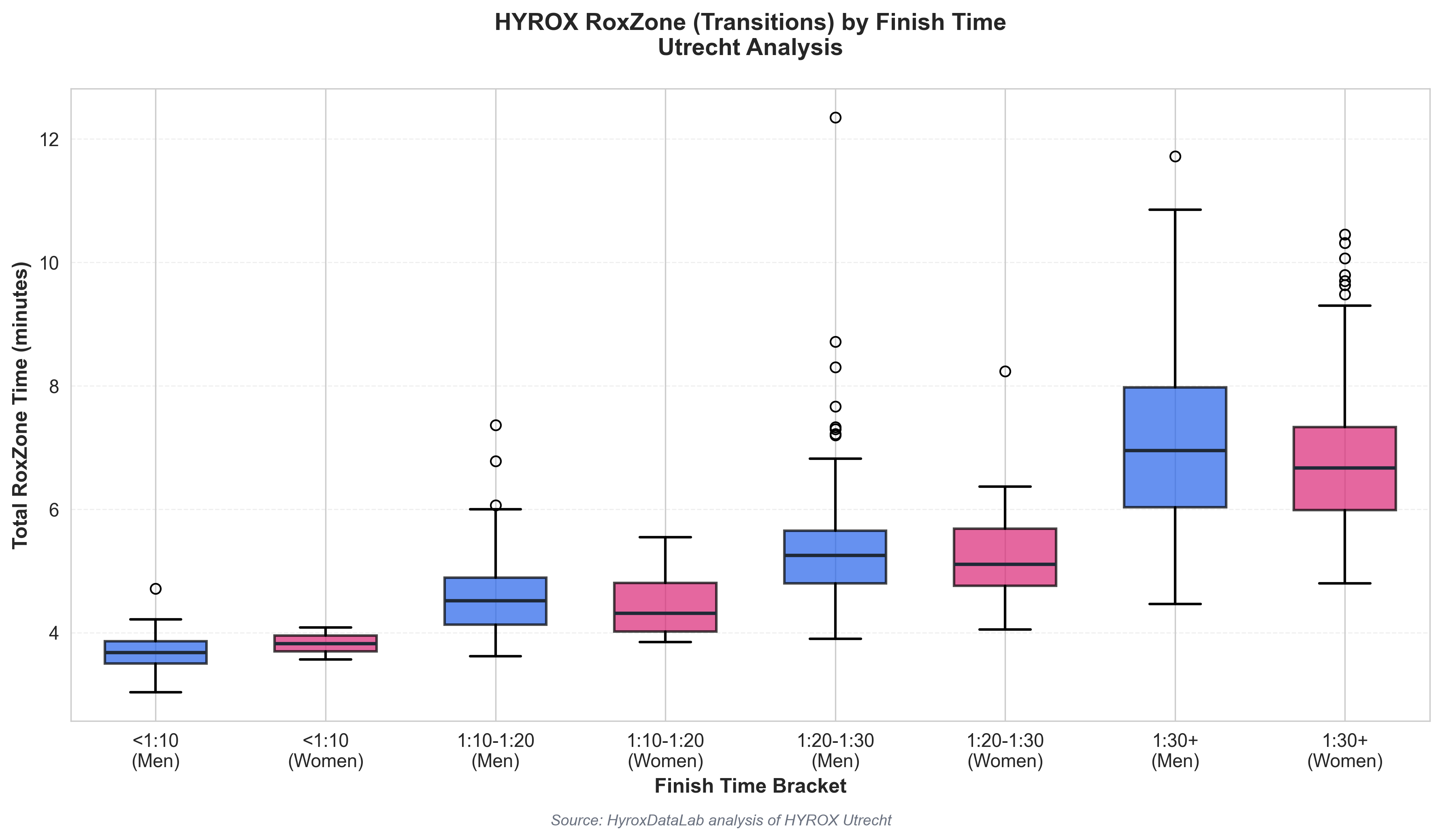
That's not a typo. Over 3 minutes of pure transition time separating recreational from elite performance. No fitness required, no strength training needed - just urgency and efficiency.
Why Slower Athletes Waste More Time
The data shows something fascinating: as finish times increase, RoxZone doesn't just increase in absolute terms - it increases as a percentage of total race time.
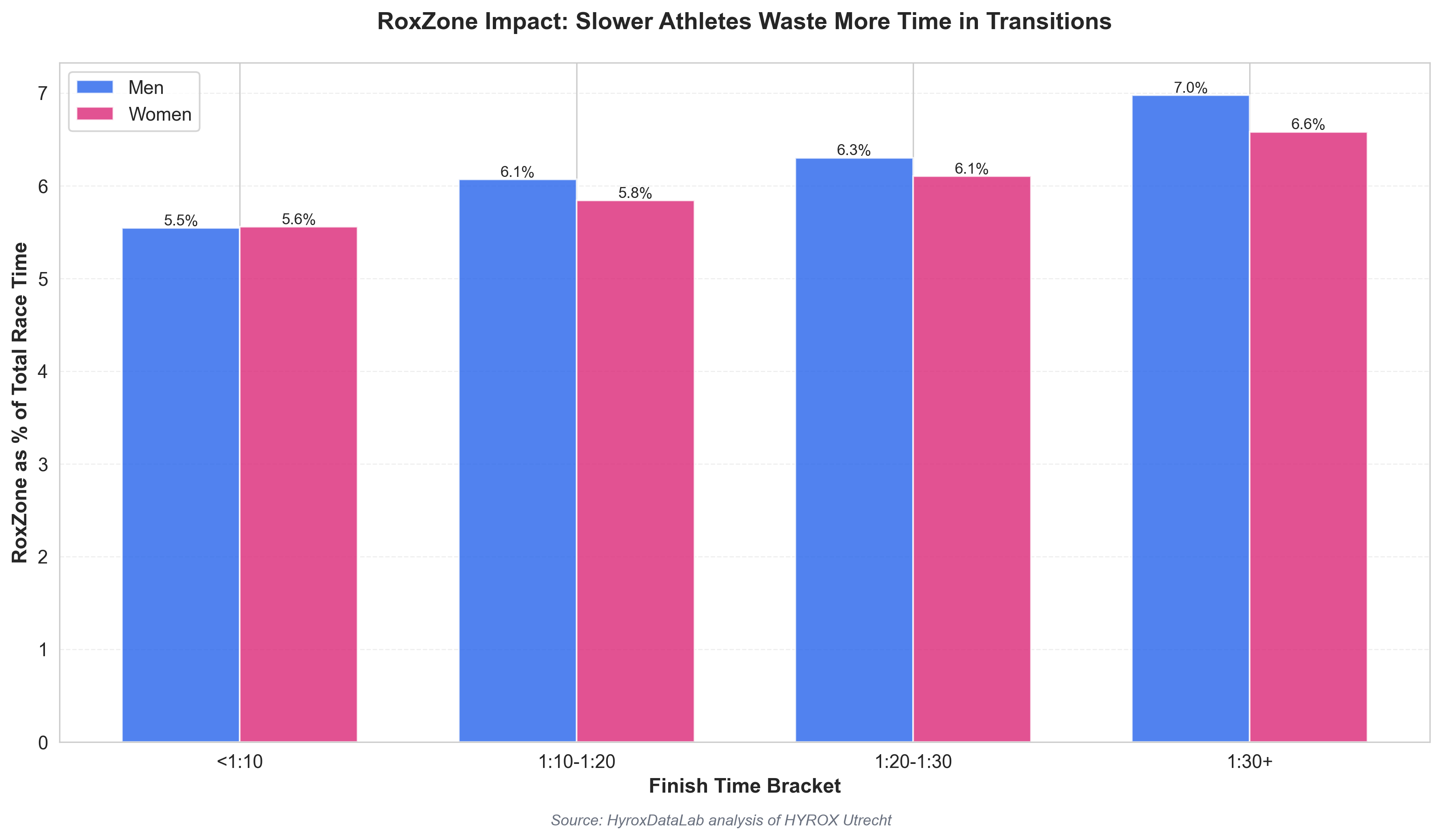
Elite athletes (under 1:10): 5.5% of race in transitions
Recreational (1:30+): 6.8% of race in transitions
Why? Three reasons:
1. Mental Gear Shifting
Elite athletes operate with constant urgency. The moment they complete a station, their brain is already on "move to next task." They're jogging to start the next run before their heart rate settles.
Recreational athletes tend to mentally "complete" the station, take a breath, walk, adjust clothing, maybe grab water. These micro-recoveries add 5-10 seconds per transition.
Over 8 transitions: 40-80 seconds lost.
2. Equipment Familiarity
Elite athletes have raced multiple times. They know:
- Exactly how to position the sled handles
- Which side of the SkiErg to approach from
- How to grab farmers carry kettlebells efficiently
- Where the sandbag pickup zone is
First-timers waste 3-5 seconds per station just figuring out logistics.
3. Fatigue Resistance
This is counterintuitive: elite athletes are MORE fatigued (higher intensity) but move FASTER between stations. Why?
Aerobic capacity. Elite athletes recover faster between high-intensity efforts. Their heart rate drops quicker, allowing them to jog (not walk) to the next station without feeling like they're going to die.
Recreational athletes hit a station hard, finish, and their heart rate is pinned. Walking feels necessary. Jogging feels impossible.
Result: 10-15 seconds per transition moving at walking pace (2-3 mph) vs jogging pace (5-6 mph).
Transition-by-Transition Breakdown
Let's break down all 8 transitions and where time is typically lost:
Transition 1: SkiErg → Run 2
What's happening: Arms and shoulders burning from 1000m SkiErg, now pivoting to leg-dominant running.
Time wasters:
- Shaking out arms while standing still (5-10s)
- Adjusting clothing/shoes after SkiErg (10-15s)
- Walking instead of slow jogging (5-10s)
Elite move: Shake arms while jogging to run start. Adjust nothing. Go.
Target transition: under 35 seconds
Transition 2: Sled Push → Run 3
What's happening: Legs obliterated from 152kg/102kg sled push. Mental relief that "the worst is over."
Time wasters:
- Standing up slowly, hands on knees (10s)
- Walking back around sled to exit zone (5s)
- Stopping to catch breath before running (10-15s)
Elite move: Stand immediately, purposeful walk around sled, begin slow jog before heart rate settles.
Target transition: under 40 seconds
Transition 3: Sled Pull → Run 4
What's happening: Lats and grip smoked, legs still recovering from push.
Time wasters:
- Tangled in pull rope (5s)
- Slow navigation around sled (5s)
- Extended recovery walk (15-20s)
Elite move: Drop rope cleanly, decisive exit path, controlled jog out.
Target transition: under 40 seconds
Transition 4: Burpee Broad Jumps → Run 5
What's happening: Full-body fatigue. Metabolically expensive station. Mental "halfway done" milestone.
Time wasters:
- Celebrating/relief at finish line (5-10s)
- Extended standing recovery (10-15s)
- Slow transition to run pace (10s)
Elite move: Cross line, no celebration, immediate transition to shuffle-jog.
Target transition: under 50 seconds (recovery is necessary here)
Transition 5: Rowing → Run 6
What's happening: Lower back tight, hip flexors shortened from rowing position. Second half of race begins.
Time wasters:
- Slow dismount from rower (5s)
- Stretching lower back while stationary (10s)
- Walking to run start (15s)
Elite move: Efficient dismount, stretch while moving, controlled jog.
Target transition: under 35 seconds
Transition 6: Farmers Carry → Run 7
What's happening: Grip fatigue, traps burning. Shortest transition distance typically.
Time wasters:
- Dropping kettlebells carelessly (5s)
- Shaking out hands while standing (10s)
- Adjusting clothing after carry (5s)
Elite move: Controlled KB placement, hand shake while walking, immediate jog.
Target transition: under 30 seconds (shortest distance)
Transition 7: Sandbag Lunges → Run 8 (FINAL RUN)
What's happening: Quads destroyed, mentally exhausted. One final 1km run before wall balls ends the race.
Time wasters:
- Dropping sandbag relief (10s)
- Extended standing recovery (15-20s)
- Walking to final run (15s)
Elite move: Sandbag down, stand immediately, purposeful walk → jog. This is where races are won.
Target transition: under 45 seconds
Transition 8: Run 8 → Wall Balls (FINAL STATION)
What's happening: Last 1km complete. 100 wall balls is all that stands between you and the finish line.
Time wasters:
- Celebrating completion of Run 8 (5-10s)
- Walking to wall ball station (10s)
- Hesitating before starting (5s)
Elite move: Cross run finish, immediate transition to wall balls. The race isn't over until rep 100 is complete.
Target transition: under 30 seconds
Note: Wall balls are the FINAL station. After completing 100 reps, there's only a short jog (~20m) to the finish line. There is NO Run 9!
The Psychology of Urgency
The single biggest difference between elite and recreational RoxZone performance isn't fitness - it's mental framing.
Recreational mindset: "I just completed that station. I need to recover before the next effort."
Elite mindset: "The station is done, but the race continues. Every second standing still is a second lost."
This psychological difference manifests in micro-behaviors:
| Behavior | Recreational | Elite | Time Cost |
|---|---|---|---|
| Post-station pause | 5-10 seconds | 0-2 seconds | 3-8s per transition |
| Movement pace | Walking (3 mph) | Jogging (5-6 mph) | 10-15s per transition |
| Equipment setup | Deliberate, careful | Quick, confident | 3-5s per transition |
| Pre-run hesitation | 5-10 seconds | 0-2 seconds | 3-8s per transition |
Total per transition: 19-36 seconds difference
Over 8 transitions: 2:32 to 4:48 lost
Our data shows recreational athletes average 52 seconds per transition vs 28 seconds for elites - a 24-second gap. Over 8 transitions, that's exactly 3:12 - matching our total RoxZone variance.
The mindset shift: Treat RoxZone like you treat running. You wouldn't stop mid-run to catch your breath. Don't stop mid-transition either.
Tactical Optimizations: The Checklist
Here's how to shave 30-90 seconds off your RoxZone time without getting fitter:
Pre-Race Preparation
Course reconnaissance (race morning):
- Walk the transition paths before racing
- Note distances between stations
- Identify any obstacles (mats, ropes, equipment)
- Plan your line for each transition
Equipment strategy:
- Shoes tied TIGHT (no mid-race adjustments)
- Minimal clothing layers (no vests or jackets to adjust)
- Pre-race bathroom visit (don't waste transitions)
- Chalk in easy-access pocket if using
During Race: Station-Exit Protocols
Implement a "3-second rule":
- 0-3 seconds: Finish station, immediate stand/exit
- 3-6 seconds: Assess orientation, begin movement
- 6+ seconds: You're already moving toward next station
Movement hierarchy (fastest to slowest):
- Jog (if heart rate allows) - ideal
- Power walk (arms swinging) - acceptable
- Regular walk (casual pace) - avoid if possible
- Standing still (hands on knees) - emergency only
Equipment touch time:
- SkiErg: Release handles, exit immediately
- Sleds: Stand, turn, walk around (don't linger)
- Rowing: One-motion dismount, no stretching while seated
- Farmers: Controlled drop, keep moving
- Sandbag: Drop and walk (don't collapse)
- Wall balls: Ball down, 2-3 breaths MAX, go
Mental Cues That Work
"The race is running, stations are interruptions."
This reframe is powerful. Most athletes think of HYROX as "8 stations connected by runs." Elite athletes think of it as "8km of running interrupted by 8 stations."
When running is the default state, transitions become urgent.
"Every second standing = one second slower finish."
RoxZone time counts DIRECTLY against your finish time. Unlike "saving energy," there's no benefit to slow transitions. The clock is running.
"Jog now, recover later."
You'll recover during the actual work (running, stations). Transitions aren't rest periods - they're just lower-intensity movement.
Training Your Transitions
Yes, you can (and should) practice RoxZone efficiency:
Workout 1: Transition Simulation
Setup: Access to all station equipment
Protocol:
- 1km run at race pace
- → SkiErg 250m (not full 1000m) → immediate transition
- → 50m sled push → immediate transition
- → 25 burpees → immediate transition
- → Row 250m → immediate transition
- → Farmers carry 50m → immediate transition
Goal: Treat every station-to-run transition like a race. Time yourself. Aim for under 40 seconds per transition average.
Frequency: Once every 2 weeks during race prep
Workout 2: Fatigue Resistance
Setup: Open space, timer
Protocol:
- 20 burpees (high intensity)
- → 10-second FAST transition to run start
- → 400m run at 5K pace
- Rest 2 minutes, repeat 5x
Goal: Train your body to transition from max effort to running without extended recovery.
Frequency: Weekly during peak training
Workout 3: Equipment Speed Drills
Setup: Race venue or gym setup
Protocol:
- Practice grabbing farmers carry kettlebells: 10 reps, time best time
- Practice mounting/dismounting rower: 10 reps, smooth and fast
- Practice sandbag placement/pickup: 10 reps, no fumbling
Goal: Muscle memory for equipment handling under fatigue.
Frequency: Weekly, 10 minutes total
Race Day Execution: The RoxZone Plan
Pre-race visualization:
- Close your eyes
- Run through ALL 8 transitions mentally
- See yourself moving with urgency
- Feel the discomfort, but see yourself moving anyway
During race checkpoints:
After Station 2 (Sled Push): How were your first 2 transitions? Too slow? Adjust now.
After Station 4 (Burpees): Halfway point. Resist the "relief walk." This is where competitors slack.
After Station 6 (Farmers): Final 2 transitions + final run. Max urgency mode.
After Station 8 (Wall Balls): Remember: the race isn't over. Don't celebrate until you cross the finish line.
The 1:30 Barrier: RoxZone Impact
For athletes targeting a 1:30 finish time (a common goal), here's the math:
Current RoxZone (intermediate bracket): 5:19
Elite RoxZone: 3:41
Potential savings: 1:38
If you're currently running 1:32 with a 5:19 RoxZone, improving to a 4:00 RoxZone (still not elite-level) would drop you to 1:30:41 - under the barrier with ZERO fitness improvement.
Your sled push didn't get faster. Your running didn't improve. You just stopped wasting time between efforts.
Common Objections (And Why They're Wrong)
"I need to recover between stations."
You'll recover better during low-intensity jogging than standing still. Blood flow aids recovery. Movement clears lactate. Standing still just makes you stiff.
"Walking saves energy for the next station."
The energy cost of a 30-second jog vs a 30-second walk is negligible (maybe 5-10 calories). The time cost is 10-15 seconds. Not worth it.
"I don't want to redline myself between stations."
You don't have to. A shuffle-jog at 70-80% effort is fine. We're not asking for sprinting. Just... move.
"My heart rate is too high to jog after stations."
Then your stations are too intense. Either:
- You're going too hard on stations (pacing issue), OR
- Your aerobic base needs work (training issue)
Fix the root cause. Don't optimize transitions around poor pacing.
Frequently Asked Questions
What's a "good" RoxZone time for my finish goal?
Important: These targets are based on Utrecht data and will vary by venue. Use them as general guidelines, but focus more on the percentage of race time (aim for under 6.5%) rather than absolute numbers.
Target RoxZone times by finish goal (Utrecht baseline):
- Sub 1:10: 3:30-4:00 total (26-30s per transition) → ~5.5% of race
- Sub 1:20: 4:00-4:45 total (30-36s per transition) → ~6.0% of race
- Sub 1:30: 4:45-5:30 total (36-41s per transition) → ~6.3% of race
- Sub 1:40: 5:30-6:15 total (41-47s per transition) → ~6.8% of race
At venues with longer transitions: Add 30-60 seconds to these totals, but the percentages should remain similar.
How do I know if my RoxZone is slow?
Check your race splits. If your RoxZone is more than 6.5% of total finish time, you're leaving time on the table. Above 7%? Significant room for improvement.
This percentage metric works across all venues, making it a better benchmark than absolute time. A 6:00 RoxZone might be great at one venue but slow at another - but 6.5% is universal.
Should I practice transitions in training?
Yes! At least 2-3 times before race day. Practice moving from high-intensity station work directly into running. Train the discomfort of not-fully-recovered transitions.
Can I fix RoxZone issues mid-race?
Absolutely. After Station 2, do a mental check: "Am I moving with urgency?" If not, adjust immediately. The beauty of RoxZone is it's 100% within your control.
Do I need equipment to train transitions?
Helpful but not required. The most important thing is training your mind to maintain urgency under fatigue. Burpees → immediate running practice works fine at home.
What if the transition area is crowded?
Move decisively but safely. Don't stand and wait - find your line and go. Crowding adds maybe 2-3 seconds per transition, not 20-30. Don't use it as an excuse.
The Bottom Line
RoxZone accounts for 6.5% of your race time and offers 3+ minutes of improvement potential without any fitness gains required.
Yet most athletes:
- Never practice transitions
- Don't think about transition strategy
- Treat stations as "complete" instead of part of continuous racing
- Walk when they could jog
- Stand when they could move
The opportunity: Shaving 10-15 seconds per transition (entirely achievable with urgency + practice) saves 1:20 to 2:00 on your finish time.
That's the difference between:
- Missing your goal and crushing it
- 10th place and podium
- A "good" race and a PR
Train your fitness. But also train your urgency. Both matter.
The clock doesn't stop during transitions. Neither should you.
Related Articles
Want to optimize other aspects of your HYROX performance?
- HYROX Sandbag Lunges Strategy - Attack don't conserve
- Improve Your Sled Push Time - Master the hardest station
- Station Performance Analysis - Where to focus training
- The Mid-Race Crisis - Managing pace degradation
Planning your race strategy?
Interactive Race Analyzer — Compare splits by category, gender, and finish time with 700,000+ real race results
Data source: Analysis of 825 athletes from HYROX Utrecht. Full methodology and additional analyses available at HyroxDataLab.com.